What Is an AI Search and SEO Growth Service?
An AI search and SEO growth service is a managed monthly program that makes a brand easier to find in Google results and easier to cite in AI-generated answers. It combines research, content, backlinks, technical fixes and tracking so the brand appears in both ranked links and assistant responses.
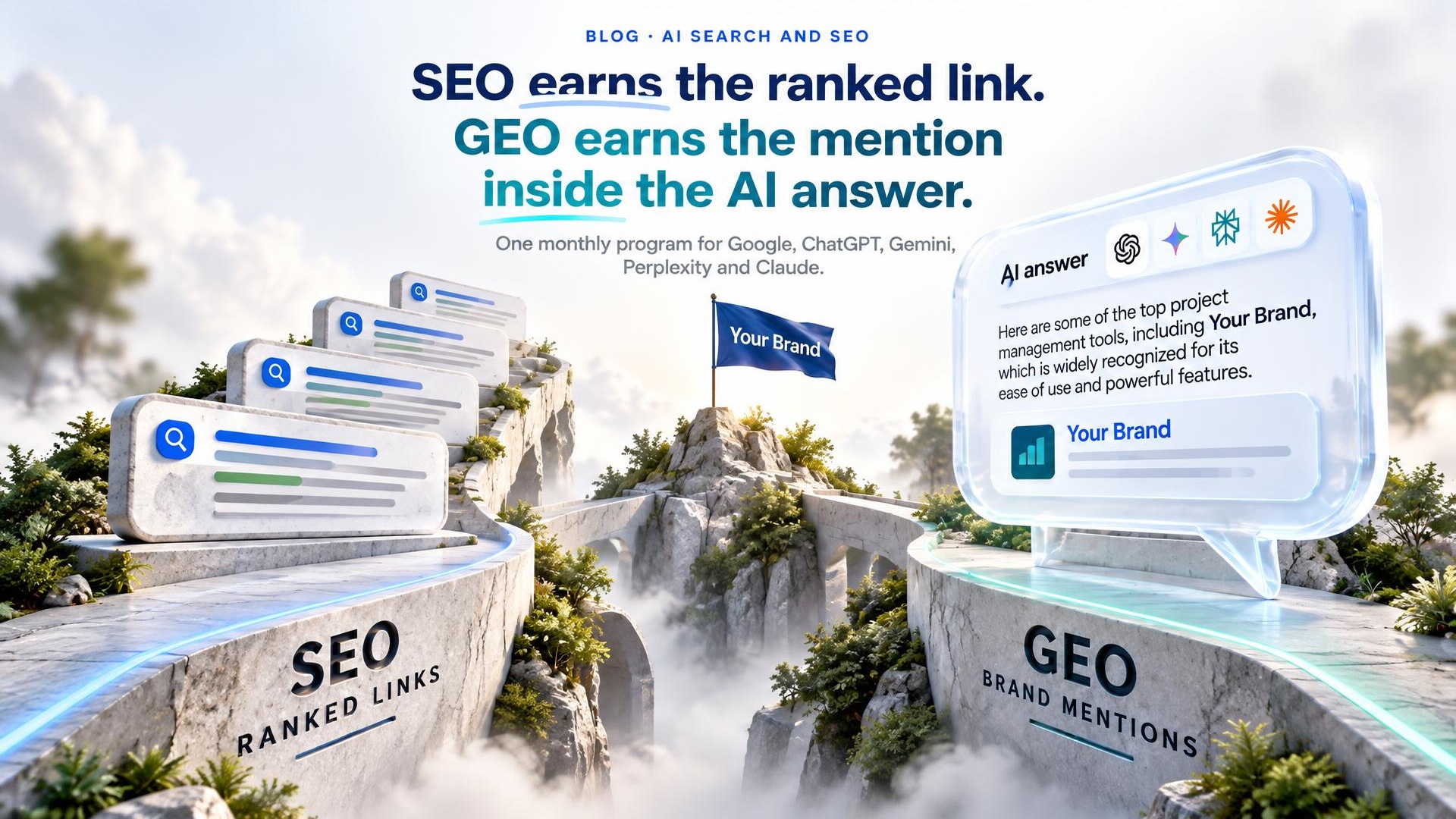
Two disciplines sit inside it. Search engine optimization (SEO) earns ranked links in Google and Bing. Generative Engine Optimization (GEO), also called Answer Engine Optimization (AEO), earns mentions inside answers from ChatGPT, Gemini, Perplexity, Claude and Google AI Overviews. Density Marketing delivers both as one retained service for businesses that want steady organic growth without building an in-house team.
Key takeaway: SEO earns the ranked link; GEO earns the mention inside the AI answer.
What Does a Monthly AI Search and SEO Program Include?
A complete monthly program includes six parts: strategy and keyword research, branded articles, backlinks, technical SEO, social visibility, and AI search tracking. Short-form video can be added. Each part targets a different barrier to being found, trusted or cited.
| Service | What it covers | Typical monthly output |
|---|---|---|
| Strategy and keyword research | Competitor analysis, SERP review, AI search insights | A 30-day content plan |
| Branded articles | Answer-first, illustrated, optimized articles in the brand’s voice | A full month of articles published to the client’s website platform |
| Backlinks | Contextual links placed within relevant industry articles | Links placed inside published content |
| Technical SEO | Page speed, meta tags, JSON-LD schema, crawlability | Flagged issues and fixes |
| Social visibility | Reddit and Quora participation, Instagram and Facebook carousels | Suggested comments and one carousel per article |
| AI search tracking | Whether assistants recommend the brand | Mention tracking across four assistants |
| Short-form video (add-on) | Original videos for each article | Videos in English and Spanish |
How Does Keyword Research and Content Planning Work?
Keyword research starts with what already ranks. The team reviews search results for the brand’s niche, groups keywords by intent, studies competitors and checks how AI assistants describe the brand, then turns the findings into a 30-day content calendar. Planning from live results reduces guesswork about what will rank.
Three inputs shape the plan:
- 1.SERP analysis. Review the pages currently ranking for target queries, their formats and their depth.
- 2.Search intent clustering. Group keywords by what the searcher wants, such as learning, comparing or buying, and assign one article per cluster.
- 3.AI search insights. Identify the questions assistants answer in the niche and the sources they cite. [CITATION NEEDED: study on which source types AI assistants cite most]
Key takeaway: A content plan built from what already ranks removes guesswork from what to publish.
What Makes an Article Rank on Google and Get Cited by AI?
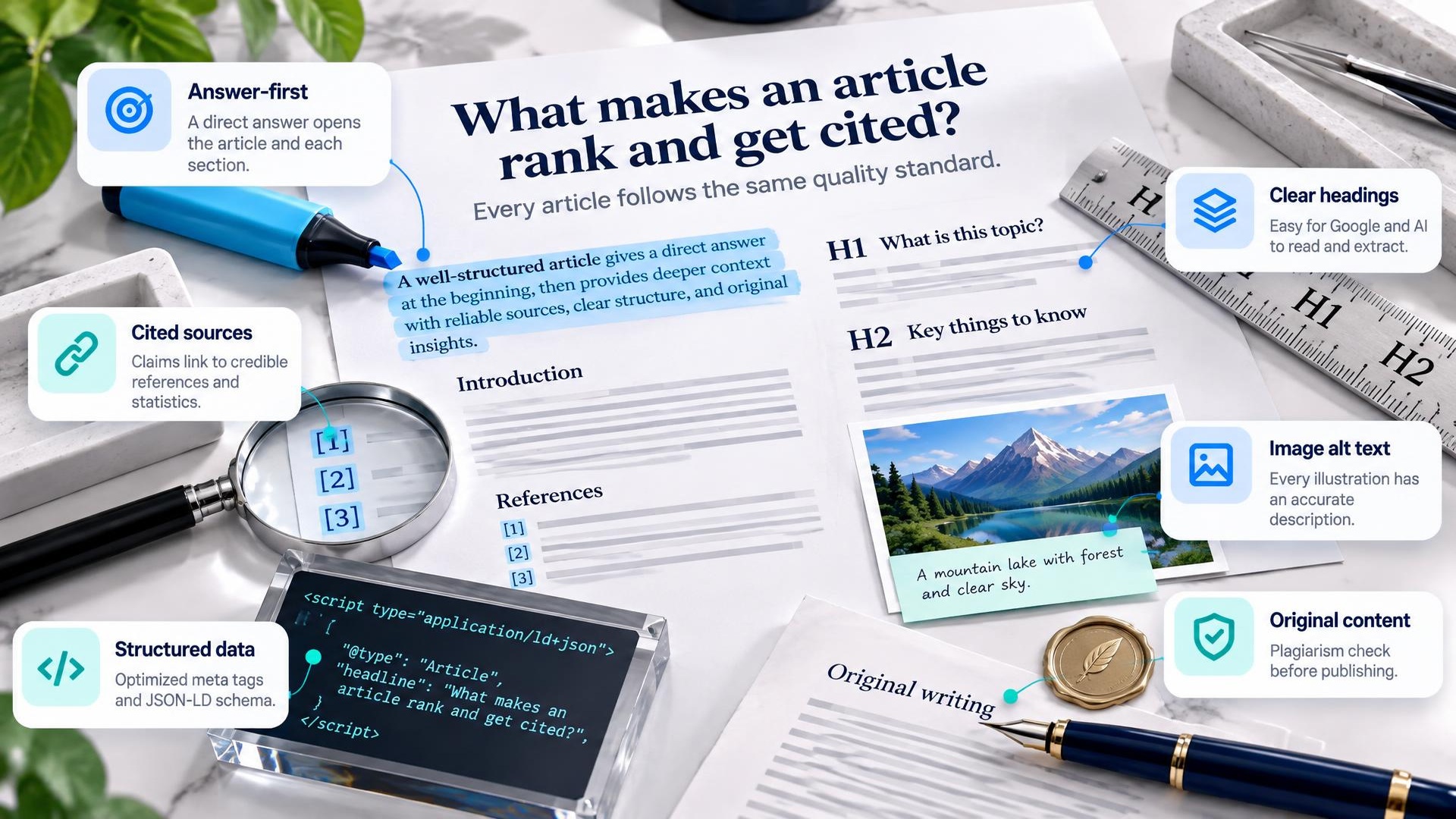
An article ranks and gets cited when it answers the question in its first lines, backs claims with credible sources, uses clear headings and includes structured data. These traits help Google evaluate quality and help language models extract and attribute a single, accurate passage.
Every article follows the same quality standard:
- Answer-first writing (BLUF): A direct answer opens the article and each major section.
- Cited sources and statistics: Claims link to credible references.
- Internal and external links: Related pages connect on the site, and authoritative references are linked out.
- Image alt text: Each illustration has an accurate description.
- Semantic keywords: Related terms and entities appear naturally.
- Optimized meta tags and JSON-LD schema: Titles, descriptions and markup are set for each page.
- Plagiarism check: Each article is verified as original before publishing.
Why Do Backlinks Still Matter for AI Search?
Backlinks remain a widely used authority signal because links from relevant sites show that other publishers trust a page. Stronger authority helps pages rank in Google, and ranked, trusted pages are more likely to be retrieved by AI tools that search the web. [CITATION NEEDED: study linking backlinks to AI citation likelihood]
The strongest links are contextual, meaning placed within the body of an article on a site in a related industry, rather than in footers or directories. A managed program places these links as part of publishing, so the client does not need to send outreach emails or negotiate with webmasters.
What Technical SEO Fixes Help Google and AI Engines Read a Site?
Technical SEO makes a site fast to load, easy to crawl and clear to machines. The most common fixes are page speed, title and meta description quality, JSON-LD schema, XML sitemaps, robots.txt rules and clean internal linking. Without these, strong content can still be missed.
| Fix | Why it matters |
|---|---|
| Page speed improvements | Slow pages lose visitors and can limit crawling |
| Meta titles and descriptions | Control how pages appear in results and summaries |
| JSON-LD schema | Labels organizations, articles, FAQs and services for machines |
| Robots.txt and sitemap checks | Confirm crawlers can reach the pages that matter |
| llms.txt file (optional) | Gives AI crawlers a concise, markdown summary of key pages; Google does not use it for ranking |
Key takeaway: Technical errors can hide good content from both Google and AI crawlers.
How Do Reddit and Quora Affect AI Visibility?
Reddit and Quora host public question-and-answer threads that AI assistants and search engines often read and reference. Thoughtful, relevant comments that mention a brand where it is useful can add context and mentions beyond the brand’s own site. [CITATION NEEDED: data on Reddit and Quora citation share in AI answers]
The approach is to find threads that match the brand’s topics, then suggest helpful, non-promotional comments that follow each community’s rules. Each published article can also become an Instagram or Facebook carousel, extending its reach to social audiences.
How Can a Business Track Its AI Search Visibility?
A business tracks AI visibility by running a fixed set of customer questions against ChatGPT, Gemini, Perplexity and Claude each month and recording whether the brand is named, how it is described and which sources are cited. Comparing results over time shows progress.
| Metric | What it shows | How to collect it |
|---|---|---|
| Brand mentions | How often assistants name the brand | Monthly prompt set across four assistants |
| Share of answer | Presence versus competitors in the same prompts | Compare named brands per prompt |
| Description accuracy | Whether services are stated correctly | Review answers against verified facts |
| Organic traffic | Visits from search | Analytics |
| Leads and sales | Business outcomes | Call, form and sales tracking |
Key takeaway: Mention frequency across AI assistants is now a core marketing metric alongside organic traffic.
How Does a Growth Program Work Step by Step?
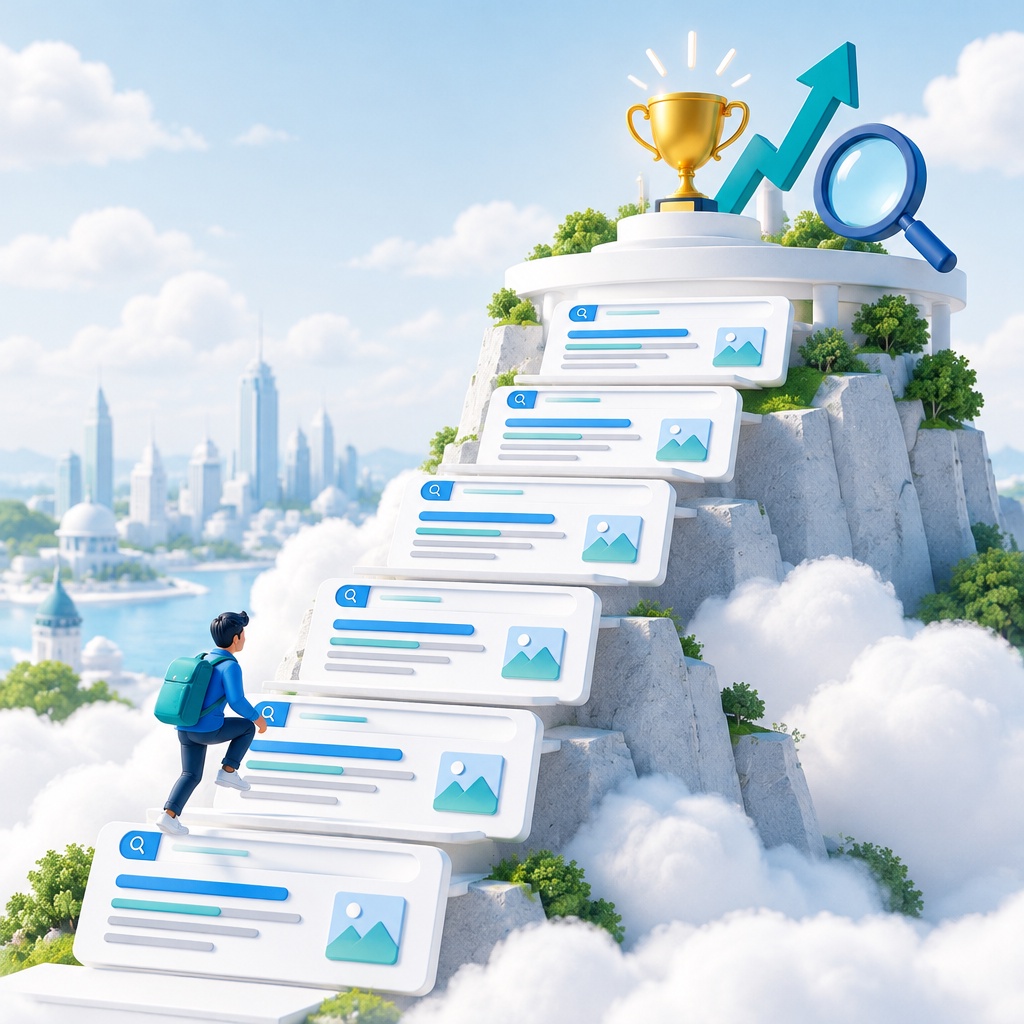
A growth program runs in three steps: understand the business, build visibility, and grow every month. It starts with research and a plan, moves to content, links and technical fixes, then repeats monthly with tracking and adjustments. Durable results typically take months. [CITATION NEEDED: typical timeframe for organic growth]
- 1.Understand your business. Review the brand, competitors, keywords and how AI assistants describe it today.
- 2.Build your visibility. Publish branded content, place backlinks, fix technical issues and start social visibility work.
- 3.Grow every month. Continue publishing and link building, track mentions and traffic, and adjust the plan as search and AI platforms change.
Frequently Asked Questions
What is the difference between SEO and GEO?
SEO earns ranked links in search results, while GEO earns mentions and citations inside AI-generated answers. They share foundations such as quality content, links and technical health, so most brands benefit from running both together.
How long does it take to see results?
Organic growth builds gradually, and many businesses look for meaningful movement over several months rather than weeks. Timing depends on the site’s starting authority, competition and publishing consistency. [CITATION NEEDED: benchmark timeframe]
Which AI assistants does the program target?
The program targets ChatGPT, Gemini, Perplexity and Claude, along with Google AI Overviews and traditional Google results. Most of the work, such as content depth, schema and authority, helps across all of them at once.
Does the business need to write or publish anything?
No. Density Marketing plans, writes, illustrates and publishes the content, handles technical fixes and tracks results. The business reviews the plan and approves direction, which keeps the time required small.
What does the service cost?
Pricing is custom and depends on the size of the site, the number of articles and the add-ons chosen, such as short-form video. Contact Density Marketing at density.marketing for a recommendation and quote.
Placeholders to Complete Before Publishing
- Study on source types AI assistants cite most
- Study linking backlinks to AI citation likelihood
- Data on Reddit and Quora citation share in AI answers
- Typical timeframe for organic growth
- Benchmark timeframe for results